Orige.net - Mapping Quotation Culture in Early Christianity through Network Analysis
Orige.net is an ambitious research project exploring how early Christian theology was shaped through practices of textual quotation. Focusing on the influential third-century theologian Origen of Alexandria, the project investigates how biblical citations formed the basis of doctrinal development, with a particular emphasis on the concept of religious freedom.
In the ancient world, the production of knowledge was deeply embedded in what scholars refer to as a 'quotation culture'- a shared intellectual practice spanning Greek, Near Eastern, Hebrew, and Chinese traditions. By applying digital network analysis (NA) and social network theory to Origen’s entire corpus, the project pioneers a novel methodological approach to ancient texts. It aims to identify and visualise intertextual links among biblical quotations, shedding light on the structural logic behind Origen's exegesis. This method allows researchers to trace how theological concepts -such as religious freedom - emerge from networks of scriptural references.
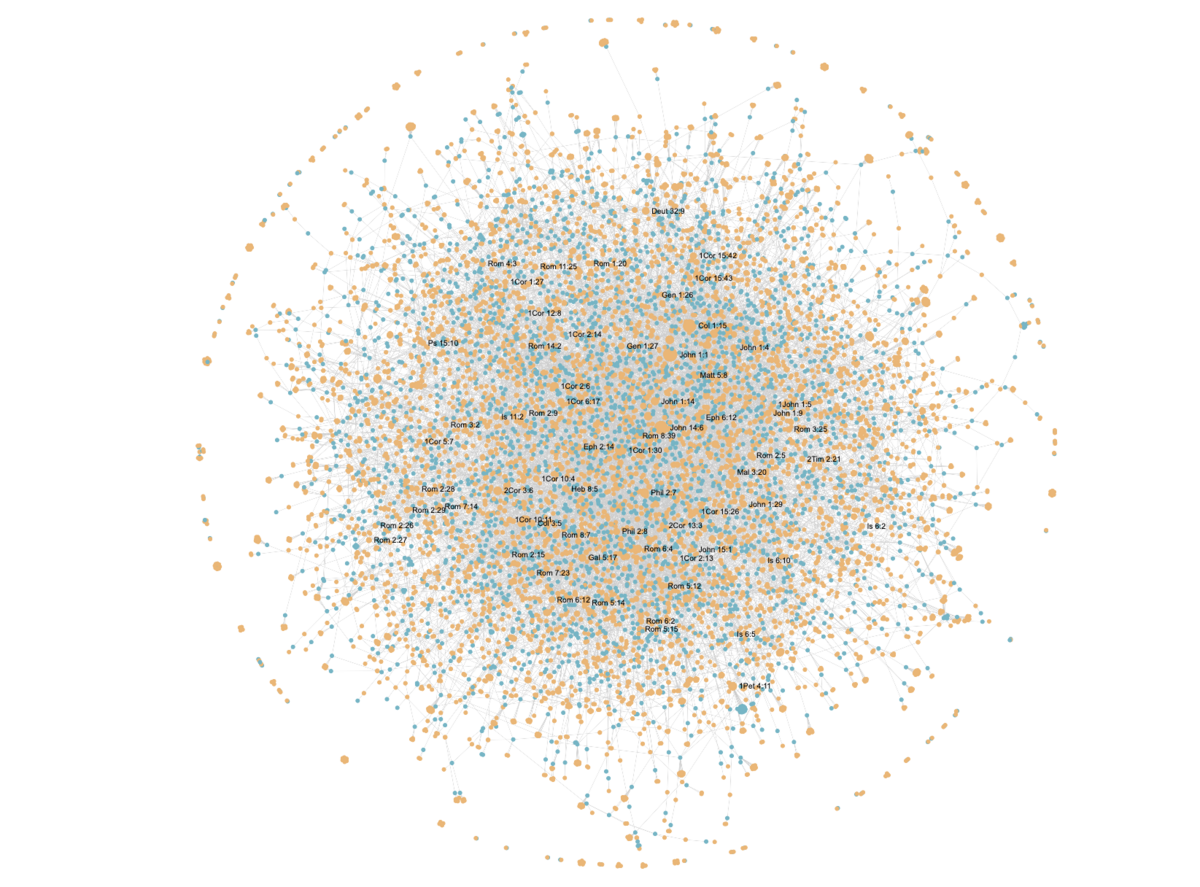
At the centre of the project is a custom-built, open-access graph database designed to visualise clusters of biblical references across Origen’s writings. The digital interface supports three core functionalities: full visualisation of the citation network, exploratory search within sub-networks, and direct access to individual quotations. By making both the tools and data publicly available, Orige.net sets a new standard for transparency and reproducibility in historical theological research.
The project is a collaborative effort by the Department of Theology and CHC, bridging the fields of theology and digital humanities and opening new avenues for studying how texts shape belief systems - and how those systems, in turn, influence broader cultural and intellectual traditions.
Role of Center for Humanities Computing
Center for Humanities Computing serves as the digital partner on Orige.net, supporting both the technical and methodological aspects of the project.
CHC is responsible for:
- Developing a graph-based data model for representing quotation networks in Origen’s corpus
- Designing a web-based application for querying and visualising the network of biblical references
- Implementing a user-friendly interface for exploring both macro- and micro-level citation patterns
- Establishing a pipeline for version-controlled, self-hosted deployment via GitHub
- Providing digital infrastructure and long-term sustainability planning for the project’s tools and data
By combining theological expertise with advanced digital methods, CHC ensures that the project’s scholarly ambitions are matched by technical robustness and usability.
Ressources:
Project affiliation
Funding
The project is funded by:
Marie Skłodowska-Curie Actions (MSCA)
Project Duration
2025 - 2027